Certification in
HR Analytics
- 06 Week Program
- IBM Accredited
- 100% Placement Assistance
- Live Online Classes

Why from KAE Education?

IBM Accredition
Stand Out With IBM Certification

300+ Hiring Partners
300+ Hiring Partner Companies
Live Capstone Project
Live Mini Projects + 1 Capstone Project with Certifications

Lifetime Access
Lifetime Access of Your Live Class Recordings
Our Hiring Partners


What is HR Analytics & Its Key Features
HR analytics—also known as people analytics or workforce analytics—is the process of collecting, analyzing, and interpreting data related to an organization’s human resources to drive better decision-making and improve both workforce and business outcomes. This approach transforms raw HR data into actionable insights, enabling organizations to understand workforce dynamics, optimize HR practices, and align talent strategies with broader business objectives.
HR analytics replaces intuition with evidence-based insights, allowing HR professionals and leaders to make informed decisions about hiring, retention, performance management, and more.
It evaluates how HR metrics—such as time to hire, retention rates, and employee engagement—affect overall business performance and strategic outcomes.
By identifying trends and patterns, HR analytics helps organizations improve productivity, reduce turnover, and plan more effectively for the future.
HR analytics elevates HR from an operational function to a strategic partner by quantifying the value HR initiatives bring to business goals.
How Different Sectors are Using HR Analytics
Tools You Will Master


Job Roles and Responsibilities
Analyzes employee data, turnover trends, and HR metrics to improve organizational policies, workforce productivity, and retention strategies.
Applies statistical methods and AI tools to derive insights from employee behavior, performance, and engagement across the organization.
Improves hiring funnels by analyzing sourcing channels, interview-to-offer ratios, and recruiter performance to reduce hiring costs and boost talent quality.
Collaborates with business and HR teams to predict future talent needs, plan headcount budgets, and align manpower with business growth targets.
Advises business leaders using insights from HR data—driving performance reviews, compensation cycles, and people strategies aligned with team goals.
Implements GenAI tools like ChatGPT to automate HR workflows, generate reports, draft HR policies, and streamline tasks like onboarding and compliance.
Course Modules
- What is HR Analytics and why it matters in a data-driven HR function
- The HR Analytics framework: define → measure → analyze → act
- Real-world case studies: attrition, hiring quality, engagement, productivity
- Setting up your environment: Python, Anaconda/Google Colab, Jupyter Notebook
- Quiz 1: HR Analytics Fundamentals
- Python syntax, variables, and data types
- Operators (arithmetic, logical, comparison)
- Strings, lists, tuples, dictionaries, sets
- Writing your first HR data script
- Conditionals (
if/elif/else) and loops (for,while) - Writing reusable functions
- Intro to NumPy arrays for numerical operations
- Quiz 2: Python Basics
- Series vs. DataFrame — the core Pandas objects
- Reading data from CSV, Excel, and SQL sources
- Indexing, slicing, filtering, and sorting HR datasets
- Hands-on: loading a sample employee dataset
- Identifying and handling missing values (
isnull,fillna,dropna) - Removing duplicates and correcting inconsistent formatting
- Data type conversions and string cleaning
- Hands-on: cleaning a messy HR dataset
- Encoding categorical variables (label encoding, one-hot encoding)
- Feature scaling and normalization
- Creating derived HR features (tenure, engagement score, etc.)
- Quiz 3: Data Cleaning & Preprocessing
groupby(),pivot_table(), and cross-tabulations- Descriptive statistics for HR metrics (attrition rate, avg. tenure, salary bands)
- Correlation analysis between HR variables
- Building bar charts, histograms, box plots, and heatmaps
- Visualizing attrition trends and departmental comparisons
- Designing simple HR dashboards in Python
- Full exploratory analysis of an employee attrition dataset
- Identifying patterns and red flags in workforce data
- Quiz 4: EDA & Visualization
- Supervised learning concepts: train/test split, features vs. target

- Logistic Regression for predicting employee attrition
- Interpreting model coefficients in an HR context
- Decision Trees for HR decision-making
- Random Forest for improved prediction accuracy
- Comparing model performance
- Confusion matrix, accuracy, precision, recall, F1-score
- ROC curve and AUC for model comparison
- Choosing the right model for a business problem
- Quiz 5: Predictive Modeling
- Unsupervised learning basics
- Segmenting employees into talent groups using K-Means
- Choosing the right number of clusters (elbow method)
- Applying clusters to targeted retention/L&D strategies
- End-to-end pipeline: clean → engineer → model → evaluate
- Interpreting results for HR stakeholders
- Translating model output into retention action plans
- Using analytics to structure performance appraisal data
- Capstone project brief: HR Analytics case study assignment
- Instructor-guided project work time
- Capstone Prep
- Capstone project presentations (attrition prediction / talent segmentation)
- Soft Skills Module: business communication and presenting analytics insights to non-technical stakeholders
- Resume & Interview Prep Module: building a data-driven HR Analytics resume, personalized feedback, common interview questions for People Analytics roles
- Course wrap-up, certification, and next steps
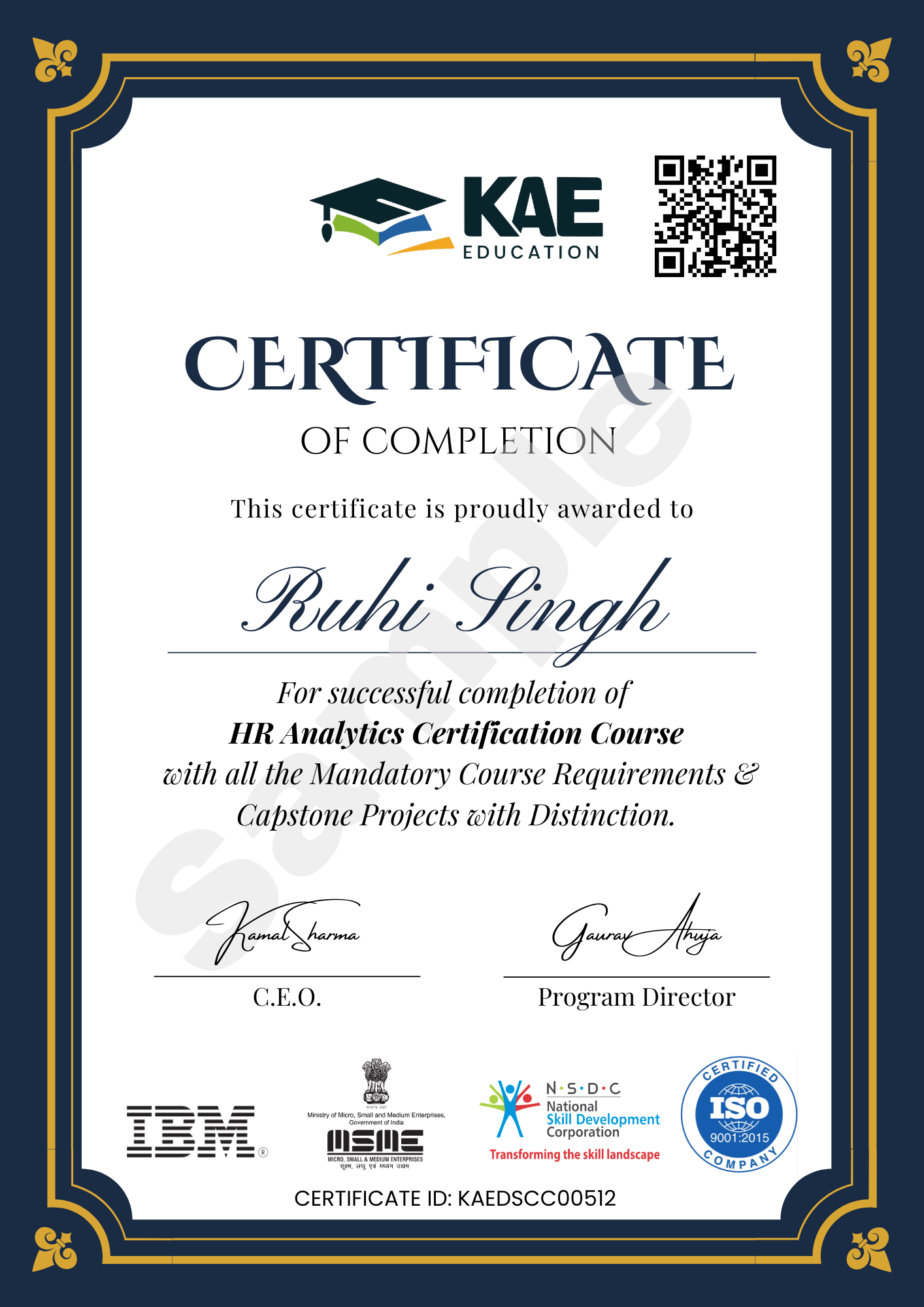
Sample Certificate

Live Class Videos
Frequently Asked Questions
This course is ideal for HR professionals, recruiters, L&D specialists, MBA graduates, and even freshers or career switchers looking to build a career in HR Analytics.
Not at all. We start from the basics of tools like Python, Excel, SQL, and Power BI. No prior coding or technical knowledge is required.
You’ll gain hands-on expertise in Excel, SQL, Power BI, Python, Tableau, and GenAI tools like ChatGPT and Microsoft Copilot.
Unlike traditional HR courses, this program is analytics- and AI-focused, designed to build data-driven HR decision-making skills.
Yes. We provide complete placement assistance including resume building, mock interviews, LinkedIn optimization, and job referrals.
You should dedicate around 6–8 hours per week, including live classes (3 days a week), assignments, and self-practice.
Media Recognition


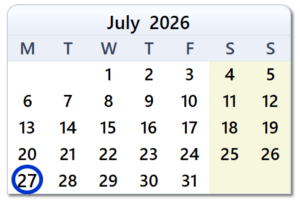
Next batch Starting27th July, 2026
Monday, Wednesday & Friday8pm to 10pm03 Days Per Week