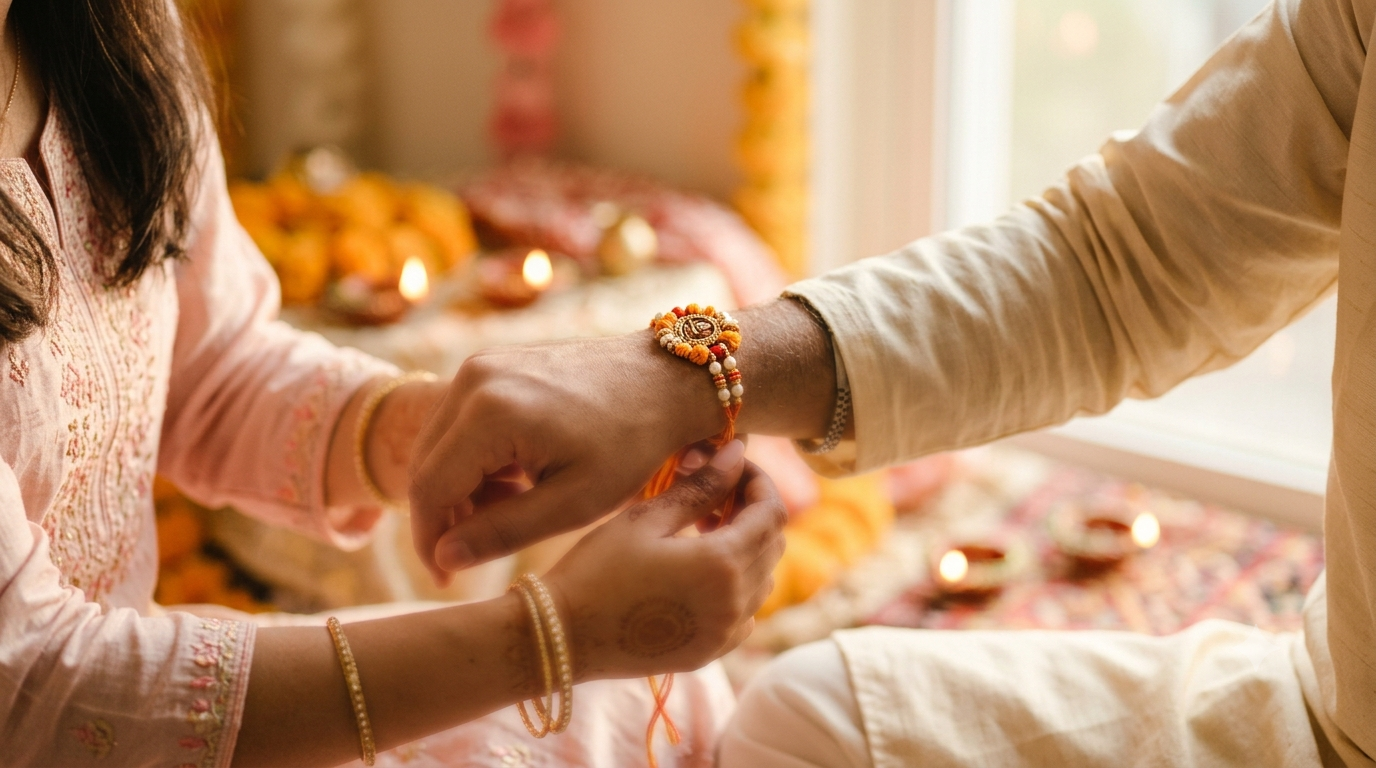
There’s a moment every sibling remembers, though most of us never talk about it.
It’s not the rakhi. It’s not the sweets. It’s the moment you realize your sibling isn’t just someone who shared your childhood — they’re the only person on earth who remembers who you were before you became who you are now.
That’s the part no one puts on the greeting cards.
We Keep Calling It a “Thread.” Maybe That’s the Whole Point.
A thread is a strange thing to build a festival around. It’s thin. It frays. A strong wind could carry it off. And yet, for thousands of years, people have tied this fragile little string around a wrist and called it protection.
Here’s the thing about threads, though — they’re not strong because of what they’re made of. They’re strong because of what they’re tied to. A thread connecting two people who show up for each other, year after year, argument after argument, distance after distance — that’s not fragile at all. That’s one of the most durable structures a human being can build.
Raksha Bandhan isn’t really a festival about rakhis. It’s a festival about maintenance — the quiet, unglamorous, deeply unfashionable act of keeping a bond alive on purpose, instead of letting it happen by accident.
And if you think about it, that’s not just a lesson about siblings. It’s a lesson about everything.
Growth Doesn’t Happen in a Straight Line. Neither Do Relationships.
We tend to think of “growing up” as something that happens to us — you get older, you get taller, you get a job, you get busier. But real growth, the kind that actually changes you, almost always happens through relationships. A sibling who challenges you. A teacher who refuses to let you settle for average. A friend who tells you the truth when everyone else is being polite.
Nobody grows in isolation. We grow in the friction and warmth of people who stay.
This is something we think about often at KAE Education — not because we teach Raksha Bandhan in a classroom, but because we’ve noticed something interesting: the students who grow the fastest aren’t always the most talented ones. They’re the ones with a strong thread somewhere in their life — a parent, a sibling, a mentor, a friend — someone whose belief in them becomes a kind of scaffolding while they figure out who they’re becoming.
Protection, in this sense, isn’t about shielding someone from difficulty. It’s about giving them a safe place to attempt difficulty. That’s what a good sibling does. That’s what a good teacher does too.
The Uncomfortable Truth About “Rakshak” (Protector)
Raksha Bandhan literally translates to “the bond of protection.” But here’s a question worth sitting with: when was the last time you protected someone by simply being honest with them?
Not comforting. Not agreeing. Honest.
The real protectors in our lives are rarely the ones who shield us from every hard truth. They’re the ones who tell us the truth and then stay anyway. The sibling who says “you’re being unfair to yourself” and doesn’t leave the room. The mentor who says “this isn’t your best work” and still shows up the next day to help you make it better.
That’s a kind of protection our culture doesn’t celebrate enough — protection from your own self-doubt, protection from giving up, protection from becoming smaller than you actually are.
So What Does This Have to Do With Education?
Everything, actually.
Education, at its best, is not information transfer. It’s relationship. It’s someone believing in a student’s potential slightly before the student believes in it themselves — and then sticking around long enough for that belief to become real.
At KAE Education, we don’t think of ourselves as just a place that prepares students for exams. We think of ourselves as one of those threads — one small, steady connection in a much bigger web of people rooting for a student’s growth. Parents tie the first thread. Siblings tie another. And somewhere in between, if we’ve done our job right, a good teacher ties one too.
None of these threads work alone. That’s the part people forget. A rakhi isn’t magic because of the thread itself — it’s magic because of what it represents: someone saying, “I see you, and I’m not going anywhere.”
A Different Kind of Rakhi
This Raksha Bandhan, we’d like to suggest a small shift in thinking.
Instead of only tying a rakhi around a wrist, tie an invisible one around a relationship that’s been quietly holding you up — a sibling, a mentor, a friend, a teacher, a student who taught you something without realizing it. Tell them. Out loud. Threads work better when both sides know they’re holding one.
Because growth was never a solo project. Neither is protection. Neither is love.
They’re all just threads — thin, unglamorous, easy to forget about — that somehow end up holding an entire life together.
Happy Raksha Bandhan, from all of us at KAE Education — to every thread that’s ever helped someone grow.
KAE Education believes learning happens best inside relationships built on trust, honesty, and staying power. This Raksha Bandhan, we’re celebrating every bond — visible and invisible — that helps a person become who they’re meant to be.