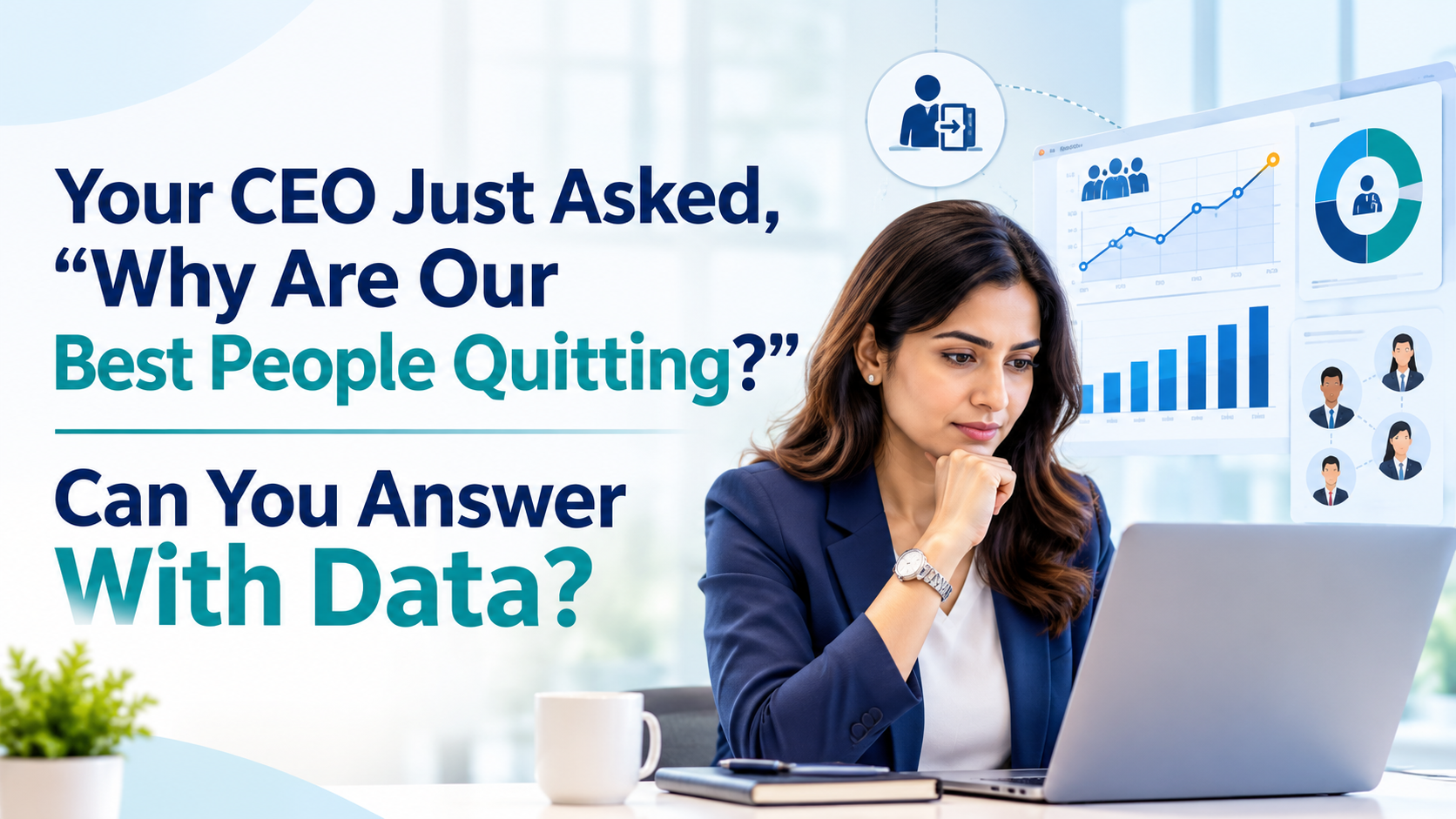
Picture this. It’s Monday, 10 a.m. The leadership meeting is in full swing, and the CEO stops on one slide and asks the question every HR professional quietly dreads:
“Attrition went up this quarter. Who is leaving, why are they leaving, and who is next?”
Two very different HR professionals can be sitting in that room.
The first one says, “I think it’s the new reporting structure… let me check with the team and get back to you.”
The second one opens a dashboard and says, “Attrition is concentrated in two departments, mostly among people in their first two years. Here are the employees most likely to leave next, and here’s what we should do about it this month.”
Now ask yourself: who gets the promotion? Who gets the call from the next company?
That gap between “I think” and “I know” is exactly what HR Analytics closes. And the best part? You can learn it in four months, even if you have never written a single line of code.
HR Is Quietly Becoming a Data Job
Not long ago, HR meant policies, payroll and paperwork. Today, leaders expect HR to bring numbers to the table, and the questions keep getting sharper:
- Why are people leaving, and which team will lose people next?
- Which hiring channel brings great hires, not just more resumes?
- Are we paying fairly across roles, grades and genders?
- Did that expensive training program actually change anything?
- How many people do we need to hire next quarter?
Every one of those is a data question. And the HR professionals who can answer them with evidence, not opinion, are the ones getting bigger roles, bigger budgets and bigger offers.
The 60-Second HR Data Test
Be honest. Can you answer these today, with numbers?
- What is your attrition rate by department, and what is driving it?
- Which recruitment source brings you your best hires?
- How long does it take to fill a role, and where does the process slow down?
- Is pay fair across similar roles?
- Did your last training program improve performance, or just attendance?
If you couldn’t answer at least three, you’re not behind because you’re not capable. You’re behind because nobody taught you the tools. And that is completely fixable.
So… What Exactly Is HR Analytics?
HR Analytics (also called People Analytics) means using data and AI to make better decisions about hiring, retention, performance and workforce planning. There’s no crystal ball and no maths PhD involved. It’s a toolkit, and once you know it, you can’t go back to guessing.
Your New Toolkit: 5 Skills That Make You Hard to Ignore
- Python: predict who’s about to resign. Analyse attrition, engagement and compensation data, and spot risk before it turns into a resignation letter.
- SQL: get any HR data in seconds. Pull clean employee, payroll and attendance data from HRIS and ATS databases without waiting on anyone.
- Advanced Excel: do in 5 minutes what takes 5 hours. Pivot tables, Power Query and HR scorecards.
- Power BI / Tableau: dashboards your management actually reads. Recruitment, retention and DEI dashboards that turn data into decisions.
- Generative AI: let AI do your daily grunt work. Use ChatGPT, Claude, Microsoft Copilot and Gemini to draft reports, emails and policies and to screen resumes faster.
Add statistics to turn raw data into measurable business decisions, and you have a skill set most HR teams are still searching for.
“Great… But Will It Actually Get Me Hired?”
That’s the honest question. Plenty of courses end with a certificate and a “best of luck.” The Advanced Diploma in HR Analytics & GenAI by KAE Education is built around the outcome instead:
- 100% Job Guarantee or Full Fee Refund, in a legal written agreement.
- A 3-month placement period after course completion.
- Minimum 5 LPA for freshers and minimum 25% hike on current CTC for experienced professionals, as per the agreement.
- 7 to 10 interviews scheduled every month by the placement team.
- 300+ hiring partners across technology, retail, BFSI, travel and telecom.
- Resume building, LinkedIn optimisation and mock interviews.
Don’t just take our word for it. Read the sample agreement before you decide. The terms matter, and we want you to read them.
What You’ll Learn: 10 Modules, 96 Hours
Classes are live and instructor-led on Zoom. Every class recording stays on your LMS for lifetime, and you get 1 year of live doubt support. Here’s the journey:
- Introduction to HR Analytics and data-driven decision making
- Data analytics essentials (SQL and Advanced Excel)
- Recruitment and workforce planning analytics (Power BI)
- Performance, productivity and workforce efficiency
- Engagement and retention analytics (build a retention dashboard)
- Compensation, benefits and workforce budgeting (automate pay analysis in Python)
- Learning, development and succession planning analytics
- Diversity, equity and inclusion (DEI) analytics (build a DEI dashboard)
- Generative AI for HR (automate an end-to-end HR report)
- Capstone project and career preparation
You’ll work on real-world HR projects and case studies, and finish with a capstone project you can showcase on your CV and GitHub profile. Want the full breakdown? Download the curriculum or the program brochure.
Jobs This Can Open Up
HR Analyst • People Analytics Specialist • Talent Acquisition Analyst • Workforce Planning Consultant • HRBP with Data Expertise • HR AI Automation Lead
You also finish with an IBM-accredited diploma certificate, which also carries NSDC, MSME and ISO marks.
Is This for You? (Even If You’ve Never Written Code)
Yes, if you are:
- an HR professional or recruiter who wants to move from reports to strategy
- an L&D specialist who wants to prove the ROI of training
- an MBA or BBA graduate, or a fresher, entering HR
- a career switcher looking at a high-demand field
No coding background is needed. The course starts from the basics. All you need is a laptop or desktop with a stable internet connection and basic computer skills.
Try Before You Commit: Watch a Real Class
Not sure about the teaching style, pace or depth? Watch the first class recording as a demo and judge for yourself, with zero commitment.
Start Before the Hiring Season Starts
Many companies reset budgets and hiring plans at the start of a new financial year, and appraisal season (April to June) tends to be when people switch jobs. The professionals who are job-ready before those windows open get first pick. Every batch you wait is another season watched from the sidelines.
Frequently Asked Questions
Is this HR Analytics course good for freshers? Yes. It starts from the basics and is built for both working HR professionals and freshers.
Do I need to know coding? No. You’ll learn Python, SQL and the other tools step by step.
How long is the course, and how is it taught? 4 months, 96 hours, delivered live online on Zoom, with lifetime access to your class recordings.
What if I don’t get a job? The program comes with a 100% Job Guarantee or Full Fee Refund agreement. The exact terms are in the agreement, so please read the sample copy before enrolling.
Which tools will I learn? Python, SQL, Advanced Excel, Power BI / Tableau, and ChatGPT, Claude, Microsoft Copilot and Gemini.
Is the certificate recognised? It is an IBM-accredited diploma certificate, which also carries NSDC, MSME and ISO marks.
Your Next Step
The next time someone asks, “Who’s leaving, and why?”, be the person with the answer.
Explore the Advanced Diploma in HR Analytics & GenAI and enrol here
Have questions? Call or WhatsApp us on +91 92586 79545.