HR Analytics Certification Course (Live Online)

About Course
Brochure | Click here to download |
|---|---|
Duration: | 32 hours |
Timeline: | 6 weeks (1.5 months) |
Format: | 16 live online sessions × 2 hours (3 sessions/week) |
Level: | Beginner → Intermediate (no prior coding needed) |
Tech Stack: | Python 3, Jupyter Notebook/Google Colab, Pandas, NumPy, Matplotlib, Seaborn, Scikit-learn |
Capstone: | End-to-end Employee Attrition Prediction Project |
Organizations today don’t just want HR professionals who understand people — they want HR professionals who can prove what they understand with data. The HR Analytics Certification Course is a fast-paced, beginner-friendly program built for exactly that shift. Over 32 hours of live, instructor-led online sessions spread across 6 weeks, you’ll go from zero coding experience to confidently building predictive models that solve real HR problems — attrition, talent segmentation, and performance evaluation — using Python, the world’s most in-demand data language.
This isn’t a theory-heavy course. Every concept is anchored to a workforce scenario you’d actually encounter on the job: Why is a high-performing team suddenly losing people? Which candidates are likely to accept an offer? How should we group employees for targeted retention or L&D investment? You’ll answer these questions the way modern People Analytics teams do — by cleaning real datasets, visualizing patterns, and building models — not by memorizing formulas in isolation.
Why Python? Python has become the default language of People Analytics and Data Science teams worldwide, thanks to its readability, its massive ecosystem (Pandas, NumPy, Scikit-learn, Matplotlib, Seaborn), and its transferability beyond HR into broader analytics and AI roles. Learning HR analytics through Python means the skills you build here don’t just make you better at your current job — they open doors into adjacent data careers as well.
What makes this course different:
- Built for beginners, priced for busy professionals. No coding background needed. We start from Python fundamentals and build up systematically — nothing is assumed, nothing is skipped.
- HR-first, not generic data science. Every dataset, case study, and project is drawn from real HR functions: recruitment, attrition, performance, engagement, and workforce planning — so you’re learning analytics in context, not analytics in the abstract.
- A complete, compact curriculum. In just 6 weeks, you’ll cover Python programming, Pandas-based data wrangling, data visualization, machine learning (logistic regression, decision trees, random forests), K-Means clustering, and model evaluation — a curriculum that typically spans much longer programs, condensed without cutting corners.
- A capstone that becomes a portfolio piece. You’ll finish the course having personally built an end-to-end employee attrition prediction model — a tangible, demonstrable project you can showcase to employers or use to pitch analytics initiatives internally.
- Career-ready, not just technically ready. The course closes with dedicated modules on communicating analytics insights to non-technical stakeholders, and on building a resume that highlights your new data capabilities — because being job-ready means more than knowing the code.
By the end of this course, you won’t just know what HR analytics is — you’ll have hands-on, demonstrable proof that you can collect, clean, model, and interpret workforce data to drive smarter, evidence-based people decisions. Whether you’re an HR professional looking to future-proof your career, an aspiring analyst specializing in people data, or a business leader wanting to bring analytics rigor to workforce decisions, this course gives you a practical, job-ready foundation in exactly the amount of time a working professional can realistically commit.
What You’ll Learn
- Python Programming Foundations — syntax, data structures, control flow, functions
- Pandas & NumPy Mastery — the core toolkit for cleaning and analyzing HR data
- Data Cleaning & Preprocessing — handling missing values, duplicates, feature engineering
- Data Visualization — Matplotlib & Seaborn for HR dashboards and storytelling
- Predictive Modeling — logistic regression, decision trees, random forests for attrition
- Clustering (K-Means) — talent segmentation and workforce grouping
- Model Evaluation — accuracy, precision, recall, F1, confusion matrix, ROC-AUC
- Applied HR Use Cases — attrition prediction, performance appraisal analytics, talent segmentation
- Career Readiness — resume building and interview prep tailored to HR Analytics roles
Why Choose Our HR Analytics Course?
There’s no shortage of online courses promising to teach you “data skills.” Here’s why professionals choose this one — and why it delivers results the others don’t:
1. Job-Ready From Day One, Not Just Certificate-Ready
Plenty of courses hand you a certificate and wish you luck. We hand you a portfolio. You’ll leave with a fully built attrition prediction model, a polished resume that speaks the language of data-driven HR, and the interview confidence to back it up. This is a course designed around what actually gets you hired or promoted — not just what looks good on a syllabus.
2. Learn by Solving Real HR Problems — Not Generic Data Science
You won’t be crunching random datasets that have nothing to do with your world. Every exercise, case study, and project is built around the problems HR teams actually face: predicting who’s about to quit, spotting flight risks before they walk out the door, segmenting talent for smarter L&D spend, and building appraisal systems people trust. You’re not learning to code — you’re learning to solve HR problems with code.
3. Python — The Skill That Keeps Paying Off
We didn’t pick Python by accident. It’s the single most in-demand analytics language in the world, which means the skills you build here don’t expire when the course ends. They compound — into better performance reviews, into promotions, into pivots to full analytics roles, if that’s where you want to go. One course, career-long leverage.
4. A Fast, No-Fluff Path to Real Capability
32 hours. 6 weeks. That’s it. We’ve engineered this curriculum to strip out the padding and theory-for-theory’s-sake content that bloats most analytics courses, so working professionals can build genuine capability without putting their careers or personal lives on hold.
5. Live, Expert-Led, and Actually Interactive
This isn’t a pre-recorded video library you’ll abandon after week two. You’re learning live, from instructors who’ve worked in analytics and HR, with real-time doubt-solving, hands-on practice, and feedback on your work — the things that actually make skills stick.
6. Soft Skills + Technical Skills, Because Both Get You Promoted
Knowing Python isn’t enough if you can’t explain your findings to a VP of HR who’s never seen a confusion matrix. That’s why we built in dedicated modules on communicating insights to non-technical stakeholders and presenting data with impact — so you’re not just technically capable, you’re organizationally influential.
7. Guidance All the Way to Your Next Role
From a data-driven resume rewrite to personalized feedback to interview preparation tailored specifically to People Analytics roles — we don’t stop at teaching you skills. We help you translate those skills into your next opportunity.
The bottom line:
This course is built for people who want results, not just certificates — a compact, practical, career-focused program that turns HR professionals into confident, in-demand HR analysts.
Frequently Asked Questions
Q1. I have zero coding experience. Will I actually be able to keep up?
Yes — this course is built specifically for beginners. We start from the absolute basics of Python and build up step by step, with live instructors guiding you through every line of code. Most of our learners walk in with no programming background at all and walk out building predictive models with confidence.
Q2. Is 32 hours really enough to learn HR analytics properly?
Absolutely — because every hour is deliberately designed around outcomes, not filler. We’ve cut the theory-heavy padding that bloats most courses and focused on exactly the skills HR analytics roles demand: data cleaning, visualization, predictive modeling, and clustering. In 6 weeks, you’ll have built a full attrition prediction project — that’s more real-world capability than many longer, less-focused courses deliver.
Q3. Why should I learn Python instead of Excel or a no-code HR tool?
Because Excel and no-code tools hit a ceiling — Python doesn’t. Python is the most in-demand analytics skill in the market, used by People Analytics teams at leading global companies. Once you know it, you can handle bigger datasets, build real predictive models, and even branch into broader data science roles if you choose. It’s a one-time investment that keeps paying off across your entire career.
Q4. Will this course actually help me get a better job or promotion?
That’s exactly what it’s built for. You’ll leave with a demonstrable capstone project, a resume rewritten to showcase your new data skills, and dedicated interview preparation for People Analytics roles. This isn’t a “watch and forget” course — it’s designed to convert directly into career outcomes.
Q5. What if I fall behind during a live session — will I be left stuck?
You won’t be. Every live session is recorded, so you can revisit anything you missed. On top of that, you get real-time doubt-solving during class and instructor support throughout the course — something pre-recorded courses simply can’t offer.
Q6. How is this different from the hundreds of other analytics courses online?
Most courses teach generic data science using random, disconnected datasets. This course is built HR-first — every case study, dataset, and project mirrors a real workforce problem: attrition, hiring, performance, engagement. You’re not learning to code in the abstract; you’re learning to solve the exact problems your HR role already deals with.
Q7. Do I need to be technical or from an IT background to succeed here?
Not at all. This course was designed for HR professionals, not engineers. If you can use Excel and are comfortable learning something new, you have everything you need to succeed. We handle the technical ramp-up for you.
Q8. What tangible proof of my skills will I have after this course?
You’ll finish with a complete, portfolio-ready attrition prediction project built entirely by you, a certificate of completion, and a resume that translates your new technical skills into language recruiters and hiring managers actually look for. That’s real, demonstrable evidence of capability — not just a line item on a certificate.
Q9. Is this course worth it if I’m not looking to switch careers, just grow in my current HR role?
Especially then. HR professionals who bring data-backed insights into hiring, retention, and performance conversations stand out immediately — and get taken more seriously in leadership discussions. This course gives you the tools to move from reporting what happened to predicting and influencing what happens next.
Q10. What happens if I enroll and realize this isn’t the right fit for me?
We want you to enroll with confidence, not hesitation — our team can walk you through our current refund and support policy before you commit, so there are no surprises either way. What we can tell you with certainty is that this course is built to deliver more practical, job-ready capability in less time than most learners expect — that’s the bar we hold ourselves to.
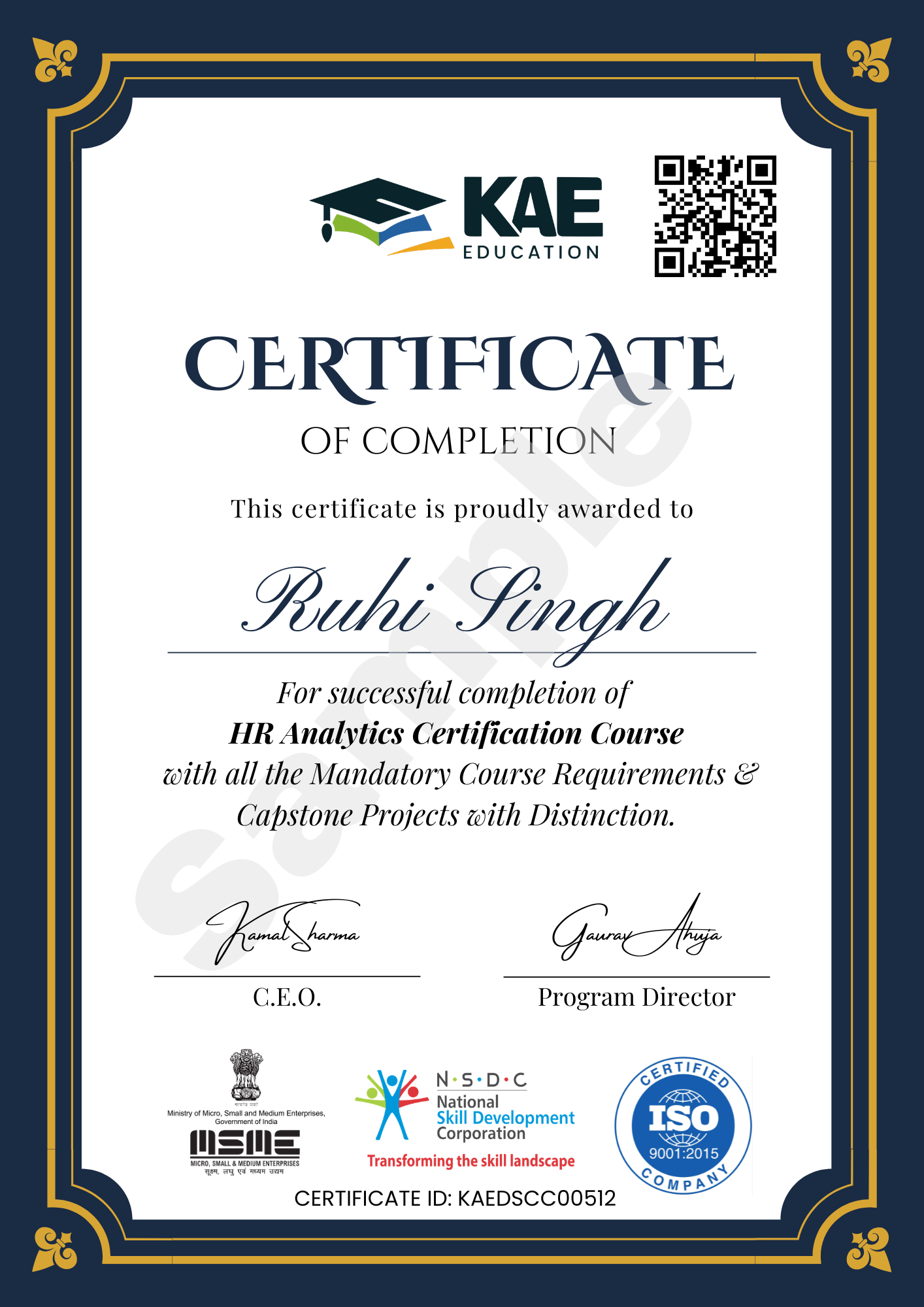
Sample Certificate
Course Content
Week 1 — Foundations: HR Analytics & Python Basics (6 hrs) Session 1 (2 hrs) — Understanding HR Analytics
What is HR Analytics and why it matters in a data-driven HR function
The HR Analytics framework: define → measure → analyze → act
Setting up your environment: Python, Anaconda/Google Colab, Jupyter Notebook
Quiz 1: HR Analytics Fundamentals