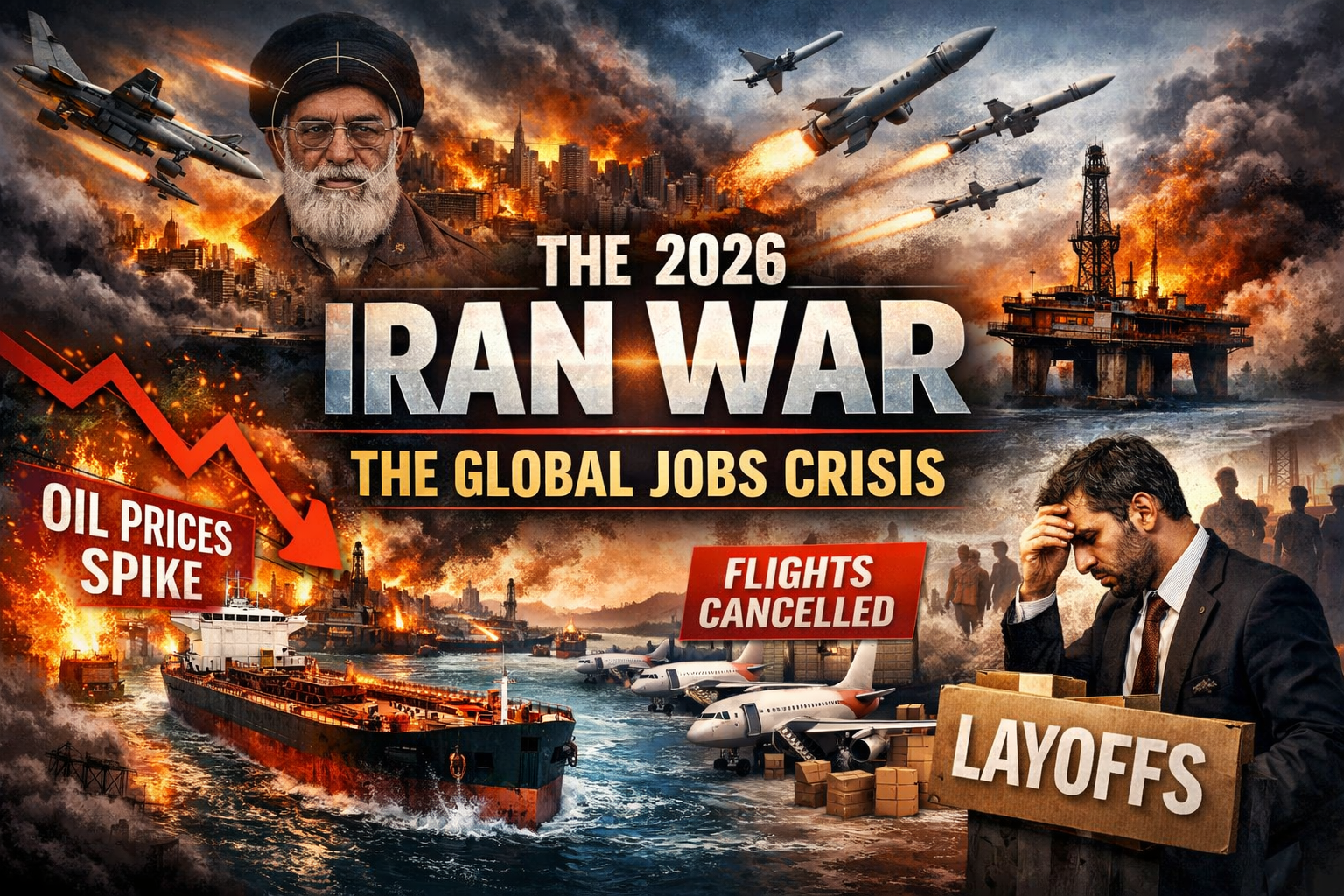
The 2026 Iran War didn’t creep up slowly — it exploded on February 28 when US and Israeli forces launched surprise strikes that killed Supreme Leader Ali Khamenei and crippled Iran’s military infrastructure. Iran retaliated with missiles and drones, closed the Strait of Hormuz (the world’s most critical oil chokepoint), and triggered the biggest energy shock since 2022.
Just two weeks in, the ripple effects are already hammering jobs worldwide. US employers shed 92,000 jobs in February (unemployment jumped to 4.4%), airlines canceled tens of thousands of flights, and CEOs are openly talking about “right-sizing” workforces because of uncertainty.
Whether you’re a software engineer in Bengaluru, an oil rig worker in Texas, or a diamond polisher in Surat, this conflict is rewriting the rules of employment faster than anyone predicted. Here’s exactly what’s happening — and what it means for your paycheck and career in 2026.
1. The Oil Price Tsunami: Inflation + Stagflation = Hiring Freezes Everywhere
Oil prices rocketed from under $70 a barrel pre-war to peaks above $120 before settling around $88–$91. The Strait of Hormuz carries 20% of global oil and LNG — and Iran has effectively shut it down.
Every 10% sustained oil price increase adds roughly 0.4% to global inflation and trims 0.2% off world GDP, according to IMF estimates. Businesses face skyrocketing fuel, shipping, and production costs. Result?
- Hiring freezes and “precautionary layoffs” — US data already shows companies announcing cuts in tech, retail, and manufacturing because consumers are tightening belts.
- CEOs openly admit the war gives them “cover” to trim payrolls they’ve wanted to cut for months.
- Energy-intensive industries (chemicals, steel, ceramics, fertilizers) are slashing shifts and delaying expansion.
Short version: Higher costs + scared consumers = fewer jobs created and more jobs eliminated.
2. Aviation & Tourism Bloodbath: 40,000+ Flights Canceled and Counting
Dubai and Doha airports — two of the planet’s busiest hubs — have been crippled. Airlines rerouted or grounded thousands of flights. More than one million passengers have been stranded, and the $11.7 trillion global travel industry is in freefall.
- Airlines, hotels, cruise lines, and ground handlers are already announcing hiring pauses and early layoffs.
- Pilots and cabin crew face route cuts and higher stress (dodging military drones isn’t in the job description).
- Tourism-dependent economies from Thailand to Turkey to the Maldives are watching seasonal jobs evaporate.
If you work in travel, hospitality, or logistics — your sector is ground zero.
3. Defense, Energy & Security: The Rare Bright Spots (Where Jobs Are Actually Growing)
Not every sector is bleeding.
- Defense contractors (Lockheed Martin, Raytheon, etc.) saw stocks surge as orders pour in. Specialized roles in missile systems, cybersecurity, and drone tech are suddenly in hot demand.
- Oil & gas companies — especially US shale and Gulf producers using alternative routes — are benefiting from sky-high prices. Exploration, refining, and trading desks are quietly hiring.
- Cybersecurity and supply-chain resilience experts are being snapped up by multinationals desperate to “de-risk” from the Middle East.
These pockets of growth prove one thing: crises don’t destroy jobs — they redistribute them.
4. India’s Unique Pain Points: Remittances, Fertilizer & Diamond Industry Under Fire
India imports 55% of its crude oil from the region and relies on the Gulf for 38% of remittances (nearly $50–60 billion annually). Around 9–10 million Indians work in Gulf construction, hospitality, oil services, and retail — sectors now directly threatened.
Already seeing:
- Fertilizer shortages hitting farmers right before planting season (India imports ~1/3 of its fertilizers; production cuts in Gulf plants are real).
- Diamond & jewellery exports delayed — Surat’s polishing units depend on Gulf trade routes and Middle Eastern buyers.
- Logistics and export delays pushing up costs for electronics, textiles, and pharma.
- Rupee weakening + higher fuel costs feeding domestic inflation.
If the war drags on, blue-collar Gulf returnees could flood the Indian job market, while agri and export sectors shed temporary workers. The ripple effect on rural employment and small businesses could be severe.
5. Long-Term Consequences Nobody Wants to Talk About
Scenario 1 (Most Likely Short-Term): War winds down in weeks → oil settles at $80–90. Temporary inflation spike, mild slowdown, selective layoffs. Job market stays “soft” but doesn’t collapse.
Scenario 2 (Nightmare Prolonged War): Strait remains closed for months → $130+ oil, global recession, widespread unemployment. Europe and Asia (heavy energy importers) suffer most; emerging markets like India face currency and remittance crises.
Either way, the old “just keep doing what you’re doing” career strategy is dead.
How to Protect (and Even Advance) Your Career in the Iran War Economy
- Skill up in resilient sectors — Energy transition, defense tech, supply-chain analytics, cybersecurity, and AI-driven efficiency are booming.
- Build a “war-proof” side hustle — Remote freelancing, digital skills, or local services that don’t rely on global shipping.
- Diversify your income geography — Gulf returnees or professionals with savings should look at opportunities in US/European energy hubs or India’s domestic defense manufacturing push.
- Negotiate now — If your company is freezing hiring, push for remote work, upskilling budgets, or performance bonuses before cost-cutting accelerates.
- Stay informed daily — Oil prices, Strait status, and US jobs reports will move faster than any policy.
The Bottom Line
The 2026 Iran War isn’t just a Middle East story — it’s a global jobs story. Energy shocks are already translating into hiring freezes, travel layoffs, and sector pivots. Some careers will vanish temporarily; others will explode.
The people who thrive won’t be the luckiest — they’ll be the most adaptable. Whether you’re staring at a pink slip or eyeing a defense-sector bonus, the next 3–6 months will separate those who react from those who reposition.
What sector do you work in? Drop a comment below — I’ll reply with tailored advice based on the latest data.
Stay sharp. The job market just got a lot more volatile — but volatility always creates opportunity for those paying attention.